On a cloudless afternoon in the foothills of the Andes, Eliana Mart?nez took off for the Amazon jungle in a single-engine Cessna 172K from an airstrip near Colombia?s capital, Bogot?. Squeezed with her in the tiny four-seat compartment were Roberto Franco, a Colombian expert on Amazon Indians; Crist?bal von Rothkirch, a Colombian photographer; and a veteran pilot. Mart?nez and Franco carried a large topographical map of R?o Pur? National Park, 2.47 million acres of dense jungle intersected by muddy rivers and creeks and inhabited by jaguars and wild peccaries?and, they believed, several isolated groups of Indians. ?We didn?t have a lot of expectation that we?d find anything,? Mart?nez, 44, told me, as thunder rumbled from the jungle. A deluge began to pound the tin roof of the headquarters of Amacayacu National Park, beside the Amazon River, where she now serves as administrator. ?It was like searching for the needle in the haystack.?
Read the full story, "Lost Tribes of the Amazon," at Smithsonian.com
Mart?nez and Franco had embarked that day on a rescue mission. For decades, adventurers and hunters had provided tantalizing reports that an ?uncontacted tribe? was hidden in the rainforest between the Caquet? and Putumayo rivers in the heart of Colombia?s Amazon. Colombia had set up R?o Pur? National Park in 2002 partly as a means of safeguarding these Indians, but because their exact whereabouts were unknown, the protection that the government could offer was strictly theoretical. Gold miners, loggers, settlers, narcotics traffickers and Marxist guerrillas had been invading the territory with impunity, putting anyone dwelling in the jungle at risk. Now, after two years? preparation, Mart?nez and Franco were venturing into the skies to con- firm the tribe?s existence?and pinpoint its exact location. ?You can?t protect their territory if you don?t know where they are,? said Mart?nez, an intense woman with fine lines around her eyes and long black hair pulled into a ponytail.
Descending from the Andes, the team reached the park?s western perimeter after four hours and flew low over primary rainforest. They ticked off a series of GPS points marking likely Indian habitation zones. Most of them were located at the headwaters for tributaries of the Caquet? and the Putumayo, flowing to the north and south, respectively, of the park. ?It was just green, green, green. You didn?t see any clearing,? she recalled. They had covered 13 points without success, when, near a creek called the R?o Bernardo, Franco shouted a single word: ?Maloca!?
Mart?nez leaned over Franco.
"Donde? Donde???Where? Where? she yelled excitedly.
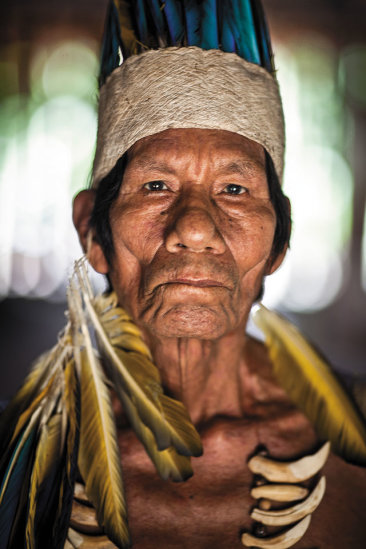 Image courtesy of Dominic Bracco II/Prime for Smithsonian Magazine.Directly below, Franco pointed out a traditional longhouse, constructed of palm leaves and open at one end, standing in a clearing deep in the jungle. Surrounding the house were plots of plantains and peach palms, a thin-trunked tree that produces a nutritious fruit. The vast wilderness seemed to press in on this island of human habitation, emphasizing its solitude. The pilot dipped the Cessna to just several hundred feet above the maloca in the hope of spotting its occupants. But nobody was visible. ?We made two circles around, and then took off so as not to disturb them,? says Mart?nez. ?We came back to earth very content.?
Back in Bogot?, the team employed advanced digital technology to enhance photos of the maloca. It was then that they got incontrovertible evidence of what they had been looking for. Standing near the maloca, looking up at the plane, was an Indian woman wearing a breechcloth, her face and upper body smeared with paint.
Franco and Mart?nez believe that the maloca they spotted, along with four more they discovered the next day, belong to two indigenous groups, the Yuri and the Pass??perhaps the last isolated tribes in the Colombian Amazon. Often described, misleadingly, as ?uncontacted Indians,? these groups, in fact, retreated from major rivers and ventured deeper into the jungle at the height of the South American rubber boom a century ago. They were on the run from massacres, enslavement and infections against which their bodies had no defenses. For the past century, they have lived with an awareness?and fear?of the outside world, anthropologists say, and have made the choice to avoid contact. Vestiges of the Stone Age in the 21st century, these people serve as a living reminder of the resilience?and fragility?of ancient cultures in the face of a developmental onslaught.
***
For decades, the governments of Amazon nations showed little interest in protecting these groups; they often viewed them as unwanted remnants of backwardness. In the 1960s and ?70s Brazil tried, unsuccessfully, to assimilate, pacify and relocate Indians who stood in the way of commercial exploitation of the Amazon. Finally, in 1987, it set up the Department of Isolated Indians inside FUNAI (Funda??o Nacional do ?ndio), Brazil?s Indian agency. The department?s visionary director, Sydney Possuelo, secured the creation of a Maine-size tract of Amazonian rainforest called the Javari Valley Indigenous Land, which would be sealed off to outsiders in perpetuity. In 2002, Possuelo led a three-month expedition by dugout canoe and on foot to verify the presence in the reserve of the Flecheiros, or Arrow People, known to repel intruders with a shower of curare-tipped arrows. The U.S. journalist Scott Wallace chronicled the expedition in his 2011 book, The Unconquered, which drew international attention to Possuelo?s efforts. Today, the Javari reserve, says FUNAI?s regional coordinator Fabricio Amorim, is home to ?the greatest concentration of isolated groups in the Amazon and the world.?
Sign up to receive the best stories each week from Smithsonian.com
Other Amazon nations, too, have taken measures to protect their indigenous peoples. Peru?s Man? National Park contains some of the greatest biodiversity of any nature reserve in the world; permanent human habitation is restricted to several tribes. Colombia has turned almost 82 million acres of Amazon jungle, nearly half its Amazon region, into 14.8 million acres of national parks, where all development is prohibited, and resguardos, 66.7 million acres of private reserves owned by indigenous peoples. In 2011 Colombian President Juan Manuel Santos signed legislation that guaranteed ?the rights of uncontacted indigenous peoples...to remain in that condition and live freely according to their cultures on their ancestral lands.?
The reality, however, has fallen short of the promises. Conservation groups have criticized Peru for winking at ?ecotourism? companies that take visitors to gape at isolated Indians. Last year, timber companies working illegally inside Man? National Park drove a group of isolated Mashco-Piro Indians from their forest sanctuary.
Colombia, beset by cocaine traffickers and the hemisphere?s longest Marxist-Leninist insurgency, hasn?t always succeeded in policing its rainforests effectively either. Several groups of Indians have been forcibly assimilated and dispersed in recent years.
Today, however, Colombia continues to move into the vanguard of protecting indigenous peoples and their land. In December, the government announced a bold new plan to double the size of remote Chiribiquete Park, currently 3.2 million acres in southern Colombia; the biodiversity sanctuary is home to two isolated tribes.
Franco believes that governments must increase efforts to preserve indigenous cultures. ?The Indians represent a special culture, and resistance to the world,? argues the historian, who has spent three decades researching isolated tribes in Colombia. Mart?nez says that the Indians have a unique view of the cosmos, stressing ?the unity of human beings with nature, the interconnectedness of all things.? It is a philosophy that makes them natural environmentalists, since damage to the forest or to members of one tribe, the Indians believe, can reverberate across society and history with lasting consequences. ?They are protecting the jungle by chasing off gold miners and whoever else goes in there,? Franco says. He adds: ?We must respect their decision not to be our friends?even to hate us.?
***
Especially since the alternatives to isolation are often so bleak. This became clear to me one June morning, when I traveled up the Amazon River from the Colombian border town of Leticia. I climbed into a motorboat at the ramshackle harbor of this lively port city, founded by Peru in 1867 and ceded to Colombia following a border war in 1922. Joining me were Franco, Daniel Matapi?an activist from Colombia?s Matapi and Yukuna tribes?and Mark Plotkin, director of the Amazon Conservation Team, the Virginia-based nonprofit that sponsored Franco?s overflight. We chugged down a muddy channel and emerged into the mile-wide river. The sun beat down ferociously as we passed thick jungle hugging both banks. Pink dolphins followed in our wake, leaping from the water in perfect arcs.
Follow @SmithsonianMag on Twitter for the latest news in science, history and culture
After two hours, we docked at a pier at the Maloca Bar?, a traditional longhouse belonging to the 30,000-strong Ticuna tribe, whose acculturation into the modern world has been fraught with difficulties. A dozen tourists sat on benches, while three elderly Indian women in traditional costume put on a desultory dance. ?You have to sell yourself, make an exhibition of yourself. It?s not good,? Matapi muttered. Ticuna vendors beckoned us to tables covered with necklaces and other trinkets. In the 1960s, Colombia began luring the Ticuna from the jungle with schools and health clinics thrown up along the Amazon. But the population proved too large to sustain its subsistence agriculture-based economy, and ?it was inevitable that they turned to tourism,? Franco said.
Not all Ticunas have embraced this way of life. In the nearby riverside settlement of Nazareth, the Ticuna voted in 2011 to ban tourism. Leaders cited the garbage left behind, the indignity of having cameras shoved in their faces, the prying questions of outsiders into the most secret aspects of Indian culture and heritage, and the uneven distribution of profits. ?What we earn here is very little,? one Ticuna leader in Nazareth told the Agence France-Presse. ?Tourists come here, they buy a few things, a few artisanal goods, and they go. It is the travel agencies that make the good money.? Foreigners can visit Nazareth on an invitation-only basis; guards armed with sticks chase away everyone else.
***
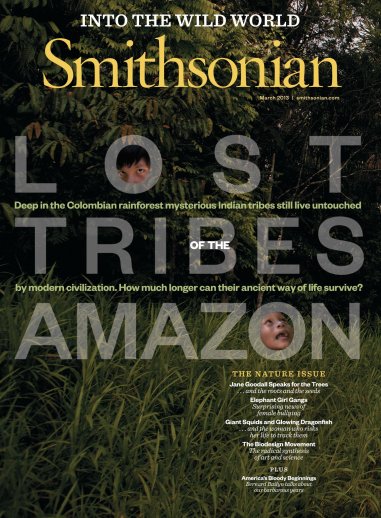 Image courtesy of Smithsonian Magazine.In contrast to the Ticuna, the Yuri and Pass? tribes have been running from civilization since the first Europeans set foot in South America half a millennium ago. Franco theorizes that they originated near the Amazon River during pre-Columbian times. Spanish explorers in pursuit of El Dorado, such as Francisco de Orellana, recorded their encounters?sometimes hostile?with Yuri and Pass? who dwelled in longhouses along the river. Later, most migrated 150 miles north to the Putumayo?the only fully navigable waterway in Colombia?s Amazon region?to escape Spanish and Portuguese slave traders.
Then, around 1900, came the rubber boom. Based in the port of Iquitos, a Peruvian company, Casa Arana, controlled much of what is now the Colombian Amazon region. Company representatives operating along the Putumayo press-ganged tens of thousands of Indians to gather rubber, or caucho, and flogged, starved and murdered those who resisted. Before the trade died out completely in the 1930s, the Uitoto tribe?s population fell from 40,000 to 10,000; the Andoke Indians dropped from 10,000 to 300. Other groups simply ceased to exist. ?That was the time when most of the now-isolated groups opted for isolation,? says Franco. ?The Yuri [and the Pass?] moved a great distance to get away from the caucheros.? In 1905, Theodor Koch-Gr?nberg, a German ethnologist, traveled between the Caquet? and Putumayo rivers; he noted ominously the abandoned houses of Pass? and Yuri along the Pur?, a tributary of the Putumayo, evidence of a flight deeper into the rainforest to escape the depredations.
The Pass? and Yuri peoples vanished, and many experts believed they had been driven into extinction. Then, in January 1969, a jaguar hunter and fur trader, Julian Gil, and his guide, Alberto Mira?a, disappeared near the R?o Bernardo, a tributary of the Caquet?. Two months later, the Colombian Navy organized a search party. Fifteen troops and 15 civilians traveled by canoes down the Caquet?, then hiked into the rainforest to the area where Gil and Mira?a had last been seen.
Saul Polania was 17 when he participated in the search. As we ate river fish and drank a?a? berry juice at an outdoor caf? in Leticia, the grizzled former soldier recalled stumbling upon ?a huge longhouse? in a clearing. ?I had never seen anything like it before. It was like a dream,? he told me. Soon, 100 Indian women and children emerged from the forest. ?They were covered in body paint, like zebras,? Polania says.
The group spoke a language unknown to the search party?s Indian guides. Several Indian women wore buttons from Gil?s jacket on their necklaces; the hunter?s ax was found buried beneath a bed of leaves. ?Once the Indians saw that, they began to cry, because they knew that they would be accused of killing him,? Polania told me. (No one knows the fate of Gil and Mira?a. They may have been murdered by the Indians, although their bodies were never recovered.)
Afraid that the search party would be ambushed on its way back, the commander seized an Indian man and woman and four children as hostages and brought them back to the settlement of La Pedrera. The New York Times reported the discovery of a lost tribe in Colombia, and Robert Carneiro of the American Museum of Natural History in New York stated that based on a cursory study of the language spoken by the five hostages, the Indians could well be ?survivors of the Yuri, a tribe thought to have become extinct for more than half a century.? The Indians were eventually escorted back home, and the tribe vanished into the mists of the forest?until Roberto Franco drew upon the memories of Polania in the months before his flyover in the jungle.
***
A couple of days after my boat journey, I?m hiking through the rainforest outside Leticia. I?m bound for a maloca belonging to the Uitoto tribe, one of many groups of Indians forced to abandon their territories in the Colombian Amazon during the rubber atrocities early in the past century. Unlike the Yuri and the Pass?, however, who fled deeper into the forest, the Uitotos relocated to the Amazon River. Here, despite enormous pressure to give up their traditional ways or sell themselves as tourist attractions, a handful have managed, against the odds, to keep their ancient culture alive. They offer a glimpse of what life must look like deeper in the jungle, the domain of the isolated Yuri.
Read about the race to save the world's dying languages at Smithsonian.com
Half an hour from the main road, we reach a clearing. In front of us stands a handsome longhouse built of woven palm leaves. Four slender pillars in the center of the interior and a network of crossbeams support the A-frame roof. The house is empty, except for a middle-aged woman, peeling the fruits of the peach palm, and an elderly man wearing a soiled white shirt, ancient khaki pants and tattered Converse sneakers without shoelaces.
Jitoma Safiama, 70, is a shaman and chief of a small subtribe of Uitotos, descendants of those who were chased by the rubber barons from their original lands around 1925. Today, he and his wife eke out a living cultivating small plots of manioc, coca leaf and peach palms; Safiama also performs traditional healing ceremonies on locals who visit from Leticia. In the evenings, the family gathers inside the longhouse, with other Uitotos who live nearby, to chew coca and tell stories about the past. The aim is to conjure up a glorious time before the caucheros came, when 40,000 members of the tribe lived deep in the Colombian rainforest and the Uitotos believed that they dwelled at the center of the world. ?After the big flooding of the world, the Indians who saved themselves built a maloca just like this one,? says Safiama. ?The maloca symbolizes the warmth of the mother. Here we teach, we learn and we transmit our traditions.? Safiama claims that one isolated group of Uitotos remains in the forest near the former rubber outpost of El Encanto, on the Caraparan? River, a tributary of the Putumayo. ?If an outsider sees them,? the shaman insists, ?he will die.?
A torrential rain begins to fall, drumming on the roof and soaking the fields. Our guide from Leticia has equipped us with knee-high rubber boots, and Plotkin, Matapi and I embark on a hike deeper into the forest. We tread along the soggy path, balancing on splintered logs, sometimes slipping and plunging to our thighs in the muck. Plotkin and Matapi point out natural pharmaceuticals such as the golobi, a white fungus used to treat ear infections; er-re-ku-ku, a treelike herb that is the source of a snake-bite treatment; and a purple flower whose roots?soaked in water and drunk as a tea?induce powerful hallucinations. Aguaje palms sway above a second maloca tucked in a clearing about 45 minutes from the first one. Matapi says that the tree bark of the aguaje contains a female hormone to help certain males ?go over to the other side.? The longhouse is deserted except for two napping children and a pair of scrawny dogs. We head back to the main road, trying to beat the advancing night, as vampire bats circle above our heads.
***
In the months before his reconnaissance mission over R?o Pur? National Park, Roberto Franco consulted diaries, indigenous oral histories, maps drawn by European adventurers from the 16th through 19th centuries, remote sensors, satellite photos, eyewitness accounts of threatening encounters with Indians, even a guerrilla from the Revolutionary Armed Forces of Colombia who had seen the Indians while on a jungle patrol. The overflights, says Franco, engendered mixed emotions. ?I felt happy and I also felt sad, maybe because of the lonely existence these Indians had,? he told me on our last morning in Leticia. ?The feelings were complicated.?
Franco?s next step is to use the photographs and GPS coordinates gathered on his flights to lobby the Colombian government to strengthen protection around the national park. He envisions round-the-clock surveillance by both semi-assimilated Indians who live on the park perimeter and rangers within the park boundaries, and an early warning system to keep out intruders. ?We are just at the beginning of the process,? he says.
Franco cites the tragic recent history of the Nukak tribe, 1,200 isolated Indians who inhabited the forests northwest of R?o Pur? National Park. In 1981, a U.S. evangelical group, New Tribes Mission, penetrated their territory without permission and, with gifts of machetes and axes, lured some Nukak families to their jungle camp. This contact drove other Nukak to seek similar gifts from settlers at the edge of their territory. The Indians? emergence from decades of isolation set in motion a downward spiral leading to the deaths of hundreds of Nukak from respiratory infections, violent clashes with land grabbers and narco-traffickers, and dispersal of the survivors. ?Hundreds were forcibly displaced to [the town of] San Jos? del Guaviare, where they are living?and dying?in terrible conditions,? says Rodrigo Botero Garc?a, technical coordinator of the Andean Amazon Project, a program established by Colombia?s national parks department to protect indigenous peoples. ?They get fed, receive government money, but they?re living in squalor.? (The government has said it wants to repatriate the Nukak to a reserve created for them to the east of San Jos? del Guaviare. And in December, Colombia?s National Heritage Council approved an urgent plan, with input from the Nukak, to safeguard their culture and language.) The Yuri and Pass? live in far more remote areas of the rainforest, but ?they are vulnerable,? Franco says.
Some anthropologists, conservationists and Indian leaders argue that there is a middle way between the Stone Age isolation of the Yuri and the abject assimilation of the Ticuna. The members of Daniel Matapi?s Yukuna tribe continue to live in malocas in the rainforest?30 hours by motorboat from Leticia?while integrating somewhat with the modern world. The Yukuna, who number fewer than 2,000, have access to health care facilities, trade with nearby settlers, and send their kids to missionary and government schools in the vicinity. Yukuna elders, says Matapi, who left the forest at age 7 but returns home often, ?want the children to have more chances to study, to have a better life.? Yet the Yukuna still pass down oral traditions, hunt, fish and live closely attuned to their rainforest environment. For far too many Amazon Indians, however, assimilation has brought only poverty, alcoholism, unemployment or utter dependence on tourism.
It is a fate, Franco suspects, that the Yuri and Pass? are desperate to avoid. On the second day of his aerial reconnaissance, Franco and his team took off from La Pedrera, near the eastern edge of R?o Pur? National Park. Thick drifting clouds made it impossible to get a prolonged view of the rainforest floor. Though the team spotted four malocas within an area of about five square miles, the dwellings never stayed visible long enough to photograph them. ?We would see a maloca, and then the clouds would close in quickly,? Eliana Mart?nez says. The cloud cover, and a storm that sprang up out of nowhere and buffeted the tiny plane, left the team with one conclusion: The tribe had called upon its shamans to send the intruders a message. ?We thought, ?They are making us pay for this,?? Franco says.
Read more great longreads at Smithsonian.com
Related stories from Smithsonian.com:
Source: http://news.yahoo.com/the-lost-tribes-of-the-amazon-202206728.html
oregon ducks rob gronkowski Coughing eddie murphy Stephanie Bongiovi stanford football guy fieri